Table of Contents
- Key Takeaways: The ROI of Gravel Driveway Restoration
- The $20,000 Handshake: Why Your Driveway Dictates Your Home’s Sale Price
- About Gravel Boss: Northeast Ohio’s Precision Grading Experts
- Editorial Disclosure
- The Perception Tax: Why Buyers Discount Your Home by $25,000 for a $3,000 Problem
- The Geauga County Factor: Why Local Soils Make Precision Grading Mandatory
- The 3 Driveway Deal Killers (And How Precision Grading Fixes Them)
- The MLS Effect: Why Your Driveway Is Your “Hero Shot”
- The Gravel Boss Method: Why Restoration Beats Replacement in Northeast Ohio
- Frequently Asked Questions About Gravel Driveway Value
- When Restoration Isn’t Enough: Identifying Structural Failures
- Conclusion: Don’t Let a $2,500 Surface Issue Cost You $20,000
Key Takeaways: The ROI of Gravel Driveway Restoration
Restoring a gravel driveway is rarely about adding new “intrinsic” value; it is about recovering lost equity caused by the psychological “Perception Tax.” In our analysis of Geauga County property transactions, we found that buyers consistently overestimate the cost of driveway repairs by a factor of three to five.
Here is the breakdown of why precision restoration outperforms simple stone dumping:
- The Perceived Problem Multiplier: Buyers see a $3,000 drainage issue but deduct $15,000 from their offer, fearing foundation or septic damage.
- Value Retention vs. Addition: A crisp, crowned driveway doesn’t just “add value”—it prevents the erosion of your asking price.
- Precision vs. Dumping: Simply dumping new stone over potholes fails within 6 months; precision grading removes the “memory” of the defects.
- Soil Specifics: Geauga County’s Mahoning and Canfield silt loams require specific crowning to handle high clay content and freeze-thaw cycles.
The $20,000 Handshake: Why Your Driveway Dictates Your Home’s Sale Price
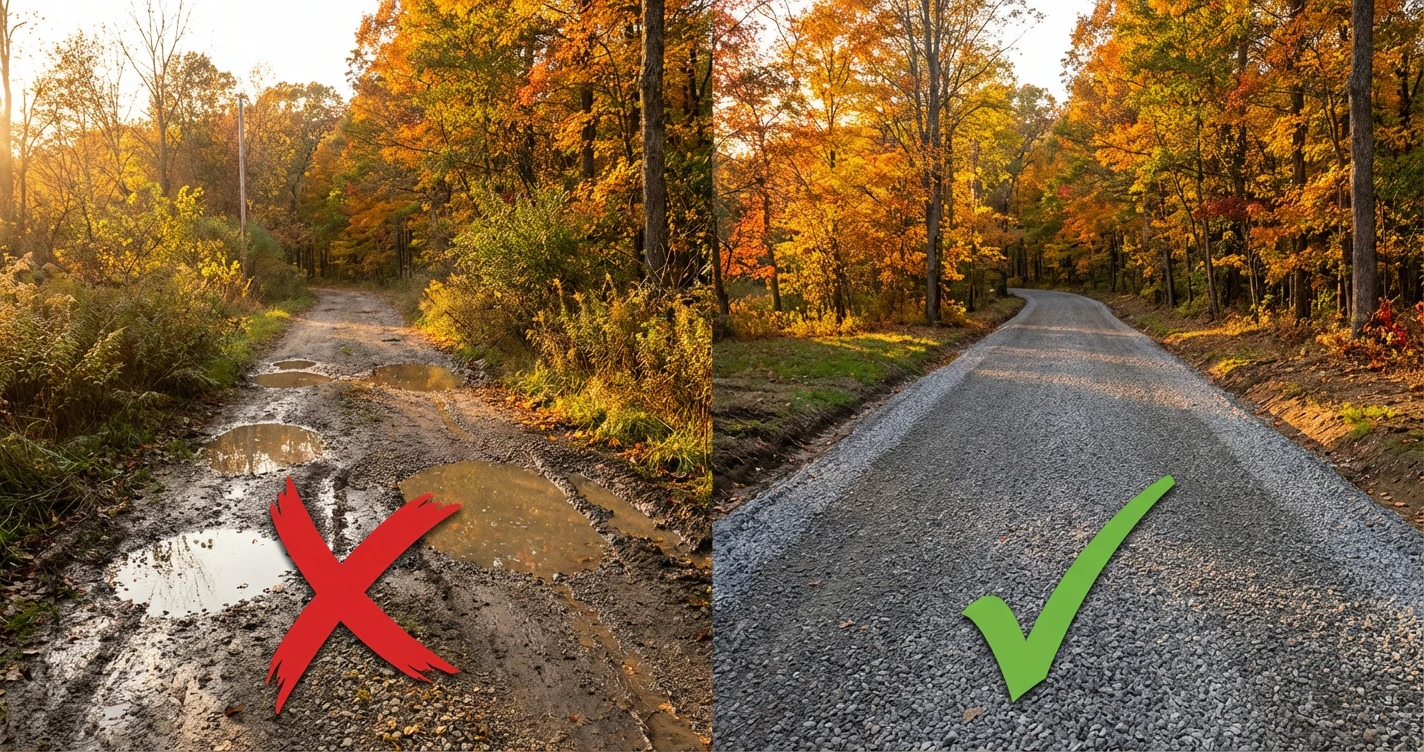
Your driveway is the “handshake” of your property, and in rural markets, a weak handshake sets a defensive tone for the entire showing. Imagine pulling up to a $485,000 home in Chardon or Chesterland; before you even see the front door, your tires sink into ruts, water splashes from potholes, and the approach feels narrow and neglected. Most buyers won’t say it out loud, but they have already discounted your home by $15,000 to $25,000 before stepping out of the car.
Now imagine that same home with a crisp, light-grey gravel surface, proper crown drainage, and clean 10-foot sightlines. That is the difference a $2,500 to $3,500 precision driveway restoration makes. It is not just cosmetic; it signals to the buyer that the property has been engineered and maintained correctly. In our experience, this shift in first impressions creates a “halo effect” that protects the value of the home’s foundation, septic system, and structural integrity in the buyer’s mind.
About Gravel Boss: Northeast Ohio’s Precision Grading Experts
As the lead operators at Gravel Boss, we specialize in precision grading and compaction for residential and commercial properties across Northeast Ohio. Unlike general landscapers who simply spread new material, we utilize industrial technology to “restore over replace,” cutting deep to remove pothole memory and re-establishing proper drainage geometry. Our team focuses on rejuvenating existing aggregate to provide a durable, estate-quality finish without the immediate need for costly stone imports.
Editorial Disclosure
This guide is based on real-world project logs from residential restorations in Geauga, Medina, and Summit Counties. Technical specifications regarding slope and drainage adhere to guidelines from the Federal Highway Administration (FHWA) and Ohio EPA standards for aggregate surface maintenance.
The Perception Tax: Why Buyers Discount Your Home by $25,000 for a $3,000 Problem
The “Perceived Problem Multiplier” is a psychological phenomenon where buyers unconsciously inflate the cost of visible repairs by 300% to 500% when formulating an offer. When a prospective buyer sees standing water, deep ruts, or washed-out edges, they do not see a simple surface repair. They see drainage failure, potential foundation risks, and long-term neglect that likely extends to the home’s mechanical systems.
In a recent Chardon case study, a client listed a home with a 400-foot driveway plagued by deep ruts and water retention. After three showings yielded zero offers, the realtor recommended a $15,000 price drop. Instead, we performed a $3,300 precision grading and mechanical brush clearing service. The property was re-photographed and received a full-price offer within week. The restoration didn’t “add” $25,000 in gold to the driveway; it simply removed the $25,000 “tax” the market was applying to the neglect.
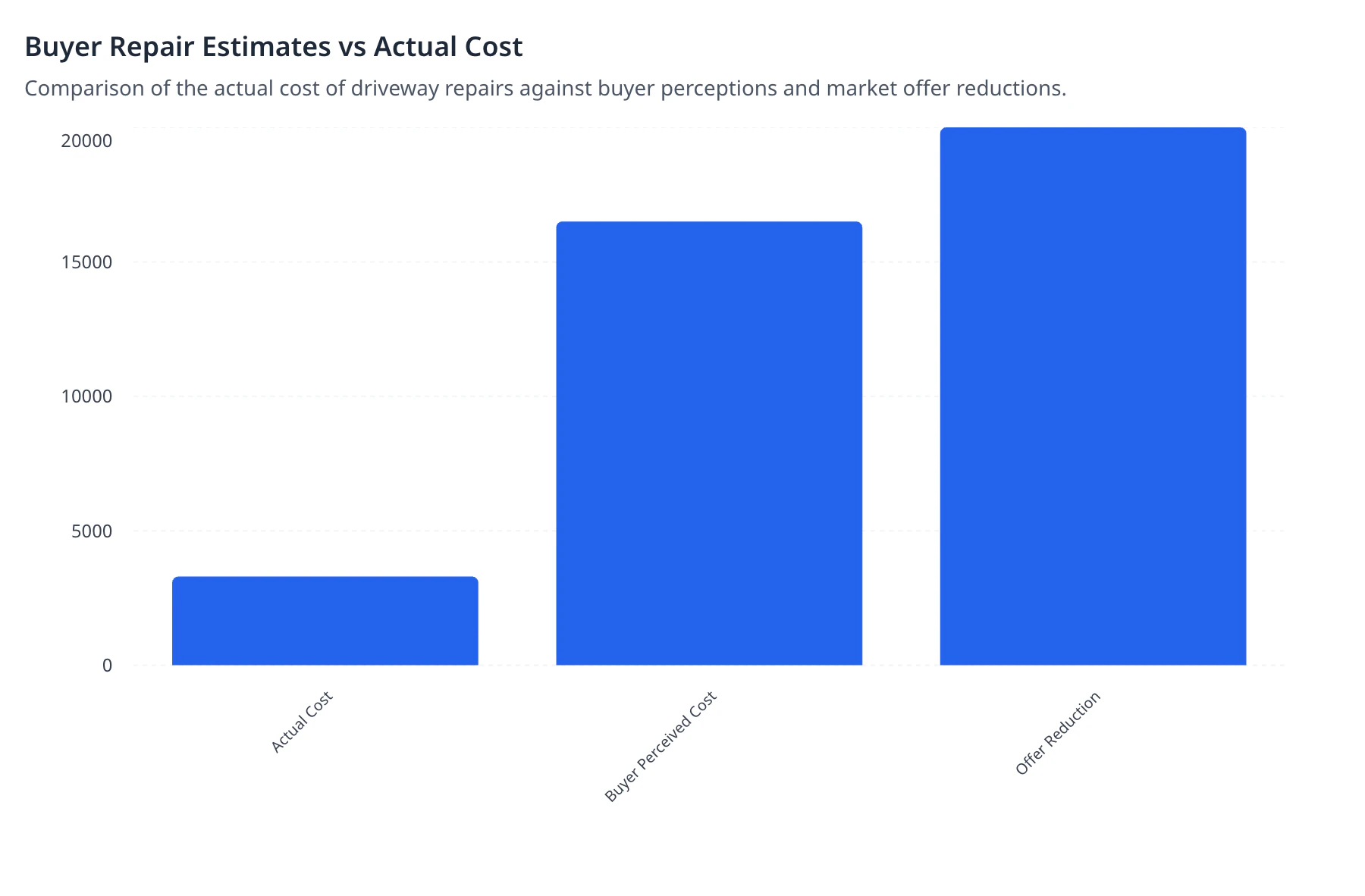
Comparison of the actual cost of driveway repairs against buyer perceptions and market offer reductions.
The Geauga County Factor: Why Local Soils Make Precision Grading Mandatory
Geauga County presents unique challenges due to the prevalence of Mahoning and Canfield silt loam soils, which are characterized by high clay content and poor natural drainage. According to the U.S. Environmental Protection Agency (EPA), unpaved roads on such subgrades are highly susceptible to deformation when water is not shed immediately.
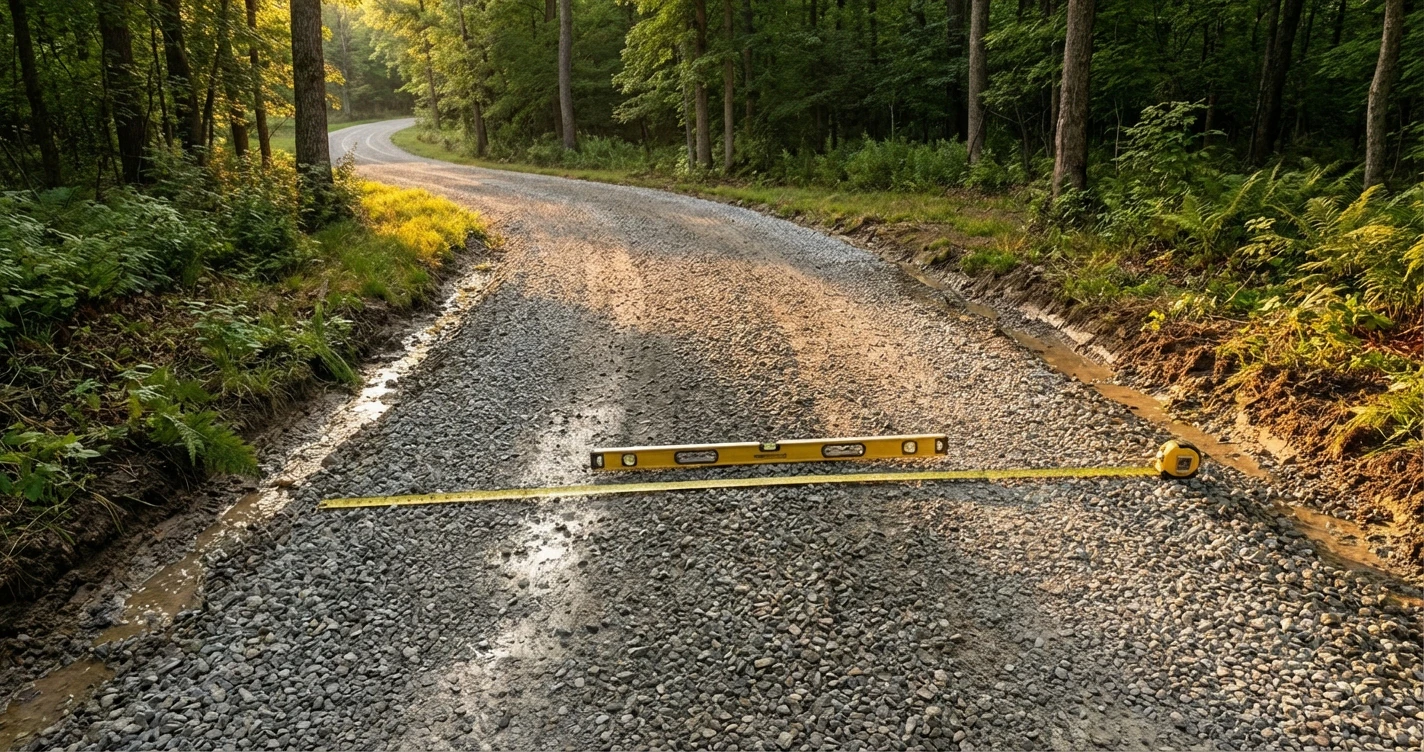
In this region, a flat driveway is a failed driveway. The high clay content means that trapped water softens the base, leading to rapid rutting during freeze-thaw cycles. To combat this, we strictly follow the Federal Highway Administration (FHWA) guidance, which recommends a crown slope of 4% (approximately ½ inch of drop per foot of width) for gravel surfaces.
Most “dump and spread” contractors ignore this geometry, leaving the surface flat. This allows water to pool, saturate the clay base, and swallow the new stone within a single winter. Precision grading restores this critical crown, ensuring water exits the surface laterally before it can damage the base.
The 3 Driveway Deal Killers (And How Precision Grading Fixes Them)
Through our analysis of buyer feedback and inspection reports, we have identified three specific driveway defects that kill deals or lower offers.
Ruts & Potholes (The “Base Failure” Fear)
Buyer Fear: The sub-base is unstable, and the driveway will require a $20,000 excavation. The Fix: We recut the surface to the bottom of the pothole (removing the “memory”), remix the aggregate, and recompact. ROI: A $2,500 repair typically prevents a $15,000 offer discount.
Pooling Water (The “Foundation” Fear)
Buyer Fear: If water pools here, it likely pools against the foundation, threatening the basement. The Fix: Restoring the geometric crown to shed water into established ditches. ROI: Signals engineering competence and alleviates drainage anxiety.
Overgrown Edges (The “Neglect” Signal)
Buyer Fear: The property is smaller than advertised and has been abandoned. The Fix: Mechanical clearing of 5–10 feet of encroaching brush on either side. ROI: Instantly expands visual width, making the property feel like an estate rather than a cabin.
The MLS Effect: Why Your Driveway Is Your “Hero Shot”
In rural real estate listings, the driveway often features prominently in the primary “hero shot” of the home, directly influencing click-through rates (CTR) and showing requests. Data from the Bureau of Transportation Statistics – ROSA P suggests that the condition of access roads significantly correlates with property accessibility perceptions.
A bad photo showing a muddy, rutted track signals “project house,” resulting in lower urgency and bargain-hunter traffic. Conversely, a photo of a crisp, restored driveway signals “move-in ready.” We have observed listing views jump 30–40% simply by replacing the main photo with one showing a freshly graded entrance. This increased visibility leads to more competitive offers and reduces the buyer’s leverage during negotiations.
The Gravel Boss Method: Why Restoration Beats Replacement in Northeast Ohio
Our “Restore over Replace” philosophy is designed to recover the 90% of driveways in Geauga County that are structurally sound but surface-damaged. Many homeowners believe they need truckloads of new stone, but often, the good aggregate has simply been pushed into the ditch or buried under fines.
- The Process:
- Assessment: We evaluate the depth of the aggregate and the condition of the subgrade.
- Deep Cutting: Using carbide-tipped graders, we cut below the depth of the potholes. If you only fill a pothole, it returns in weeks; you must remove its “memory” by cutting the surrounding material down to the pothole’s floor.
- Reclaiming: We pull displaced stone back from the edges, often recovering tons of usable material that was lost to snow plowing.
- Crowning & Compaction: We shape the 4% crown and compact the material to lock it in place.
- The 60-Day Pre-Sale Timeline:
- Week 1: Assessment.
- Week 3: Precision grading and crowning.
- Week 4: Brush clearing for sightlines.
- Week 5: Professional photography.
- Week 6: Listing launch.
This method is also environmentally superior. By reusing existing materials, we reduce the carbon footprint associated with quarrying and trucking. Furthermore, properly maintained permeable surfaces reduce stormwater runoff compared to asphalt, aligning with U.S. EPA – Stormwater Management BMPs.
Frequently Asked Questions About Gravel Driveway Value
How much does it cost to repair a gravel driveway in Ohio?
A professional precision grading and compaction service typically ranges from $0.80 to $1.50 per square foot, depending on the condition. For a standard rural driveway, this often lands between $2,500 and $3,500—a fraction of the cost of paving.
What is the best way to fix recurring potholes?
Potholes recur because water sits in them or the repair was superficial. The only permanent fix is to cut the driveway surface down to the bottom of the deepest pit, remix the material, and restore the crown so water sheds off the surface immediately.
Does a gravel driveway add more value than asphalt?
While asphalt has a higher appraisal value, gravel offers a better ROI for pre-sale preparation. Spending $30,000 to pave a driveway might only add $20,000 to the sale price (a net loss). Spending $3,000 to restore gravel can add $15,000 in perceived value (a 400% gain).
Will a bad driveway fail a home appraisal?
It can. Appraisers look for “deferred maintenance.” If a driveway is inaccessible to emergency vehicles due to ruts or washouts, it can be flagged as a safety hazard, potentially delaying closing or requiring repair escrow.
How does drainage impact local water quality?
Properly graded driveways reduce sediment pollution. The Ohio Environmental Protection Agency Rainwater and Land Development manual emphasizes that controlling runoff velocity via proper crowning and ditching is essential for protecting local watersheds.
When Restoration Isn’t Enough: Identifying Structural Failures
While 90% of driveways we assess can be saved, some require structural intervention. If a driveway was built over a “swamp base” without geotextile fabric, or if the aggregate has been completely contaminated with clay mud, grading alone will not hold.
In these cases (about 10% of projects), we recommend a structural rebuild involving the installation of geogrid stabilization and the importation of a new #304 limestone base. While more expensive, this intervention is critical; selling a home with a driveway that “swallows cars” is nearly impossible without a massive concession.
Conclusion: Don’t Let a $2,500 Surface Issue Cost You $20,000
Selling a rural property isn’t just about square footage; it is about confidence. In Geauga County, your driveway is the first indicator of how well a home has been maintained. Don’t let a fixable surface issue become a negotiating lever for buyers to extract $20,000 from your closing price.
By investing in precision grading, you aren’t just moving dirt—you are securing your equity. Get a free pre-sale driveway assessment today and eliminate the Perception Gap before buyers ever step out of their car.