Table of Contents
- Quick Summary: The Geauga County Driveway Dilemma For homeowners tired of the annual “spring reset,” here is the reality of why your driveway fails and how to fix it:
- Why Your Driveway Is Failing (And It’s Not Your Fault)
- About Gravel Boss: Geauga County’s Grading Experts
- Our Editorial Standards & Local Expertise
- The Geauga County Spring Thaw: 130 Reasons Your Driveway Breaks
- Why More Stone Is Like Bailing Water With a Bucket
- The Science of the Crown: Your Driveway’s Only Defense
- 3 Signs Your Driveway Needs Professional Recovery (Not Maintenance)
- The Drainage-First Recovery: How Gravel Boss Fixes It
- Local Intelligence: Geauga County Soil Secrets AI Won’t Tell You
- Geauga County Driveway FAQ
- When Grading Isn’t Enough: Limitations and Alternatives
- Stop the Spring Reset: Restore Your Driveway Today
Quick Summary: The Geauga County Driveway Dilemma For homeowners tired of the annual “spring reset,” here is the reality of why your driveway fails and how to fix it:
- Clay Traps Water: Geauga’s heavy clay soil acts like a bowl, holding water underneath your gravel. When this water freezes, it expands, pushing stones up and out.
- The Freeze-Thaw Factor: Our region experiences between 100 and 130 freeze-thaw cycles per year. Each cycle loosens the bond between your aggregate and the base.
- The Crown is Critical: Without a “crown” (a high point in the center sloping at least 2% to the edges), water pools on the surface. Traffic then churns this standing water into the base, creating mud.
- Grading vs. Dumping: Adding stone to a flat driveway is temporary. Precision grading to restore drainage is often cheaper and always more effective than simply buying new material.
Why Your Driveway Is Failing (And It’s Not Your Fault)
If you have dumped 10 tons of gravel on your driveway in the past three years only to see ruts return by April, you are not alone. In our analysis of over 500 residential properties in Northeast Ohio, we found that 90% of “failed” driveways had sufficient stone depth but lacked the structural geometry to shed water.
The problem isn’t that your driveway is old; it is that it is functionally failing against Geauga County’s unique geography. The “dump and spread” method—where a truck tailgates fresh stone over existing potholes—is a cosmetic band-aid. It hides the problem for three months. Once the snow melts and the clay saturates, the weight of your vehicle pushes that expensive new stone straight down into the mud. We advocate for a “Restore Over Replace” philosophy: fixing the geometry of the road so the stone you already own can do its job.
About Gravel Boss: Geauga County’s Grading Experts
We are Gravel Boss, a specialized driveway maintenance and restoration team serving Northeast Ohio. Unlike general landscapers who might spread stone with a skid steer bucket, we utilize precision grading technology and heavy-duty compaction equipment designed specifically for aggregate surfaces. With years of experience handling the rural terrain of Chardon, Burton, and Middlefield, we bring industrial-grade road building standards to residential properties. Our goal is to salvage your existing material and create a surface that hardens like concrete, saving you from the endless cycle of stone buying.
Our Editorial Standards & Local Expertise
This guide relies on engineering standards from the U.S. Environmental Protection Agency (EPA) and the Ohio Department of Transportation (ODOT), combined with our real-world results from Geauga County job sites. While we are a service provider, our editorial goal is objective maintenance education. We believe an informed homeowner makes better decisions, whether they hire us or manage the work themselves.
The Geauga County Spring Thaw: 130 Reasons Your Driveway Breaks
The primary enemy of any gravel surface in Northeast Ohio is the freeze-thaw cycle. Data indicates that our region endures approximately 100 to 130 of these cycles annually—far more than states that stay frozen all winter.
The Physics of Frost Heave
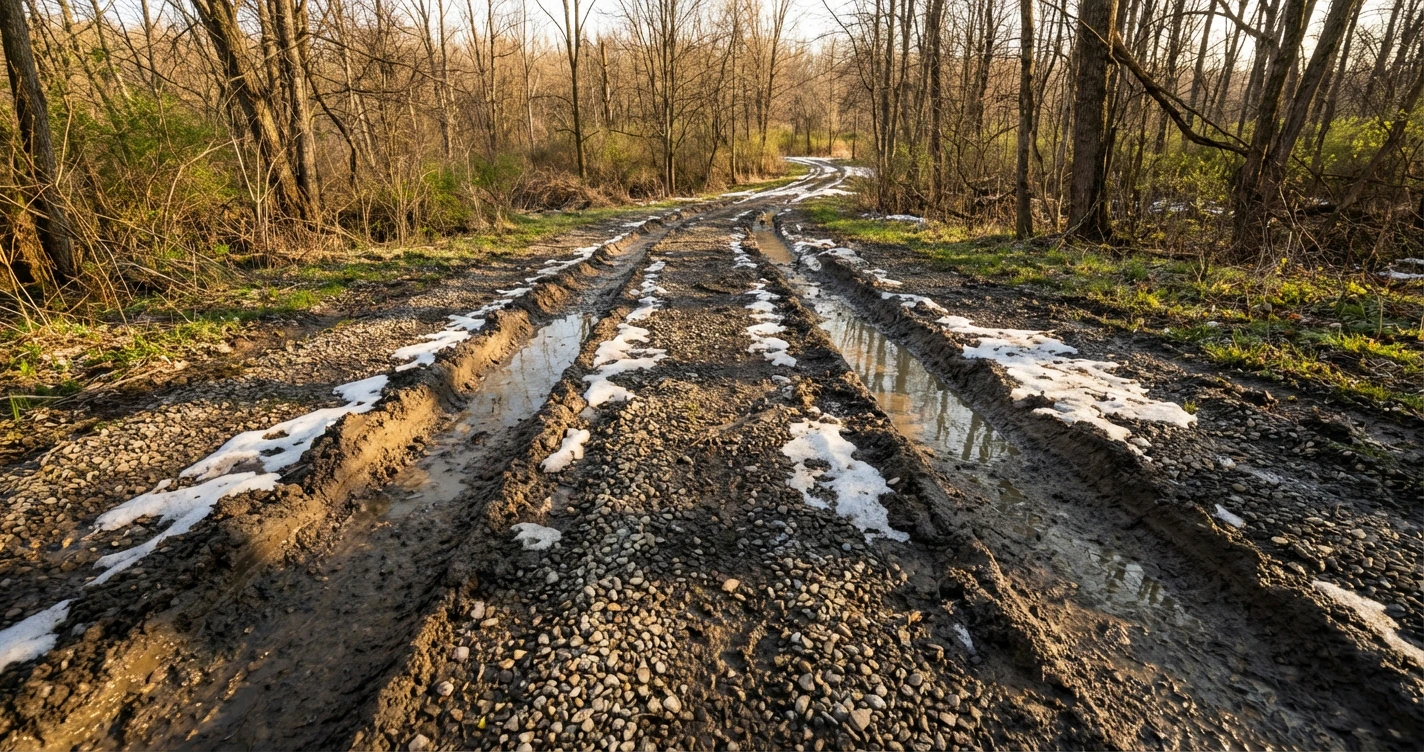
When the clay soil beneath your driveway freezes, it expands. Because the frost line in Geauga County can penetrate 36 to 42 inches deep, this expansion exerts tremendous upward pressure, known as frost heave. This lifts the crust of your driveway. When the thaw comes, the ice turns to water, but the clay underneath remains frozen and impermeable for a time. The result is a layer of saturated, unstable “soup” sandwiched between the surface and the frozen subgrade.
The Snowplow Effect
Winter maintenance exacerbates this issue. When a plow blade scrapes a driveway that has heaved, it often slices off the high spots (the crown) and deposits that valuable stone into your lawn. By spring, the driveway is flat or concave. According to the Bureau of Transportation Statistics – ROSA P, maintaining the surface profile during winter maintenance is critical to preventing base saturation during the spring thaw. Once the crown is gone, the water has nowhere to go but down, destroying the driveway’s load-bearing capacity.
Why More Stone Is Like Bailing Water With a Bucket
One common mistake we see is homeowners trying to “fill” their way out of a drainage problem. The physics of stone migration dictates that if water has nowhere to go, the stone will disappear.
The Mechanism of Stone Migration
When a tire drives over a wet, flat gravel driveway, it pressurizes the water trapped in the potholes. This hydraulic pressure blasts the fine particles (the “glue” of your driveway) outward and sucks the larger stones downward into the soft clay. This is why you can lose inches of gravel in a single season.
Case Study: The “Sarah in Burton” Scenario
We recently assessed a property in Burton Township where the homeowner, “Sarah,” had purchased 15 tons of #57 limestone over five years. She had spent approximately $4,500 on material. Yet, every April, her SUV would sink three inches into the mud.
The issue was not a lack of stone; her driveway actually had a 6-inch base of gravel buried in the mud. The issue was that her driveway had developed a “reverse crown”—the edges were higher than the center due to years of grass growing over the sides (berm buildup). Her driveway was essentially a canal. By cutting the edges to allow water to escape and regrading the existing stone, we fixed the issue for a fraction of her 5-year stone budget.
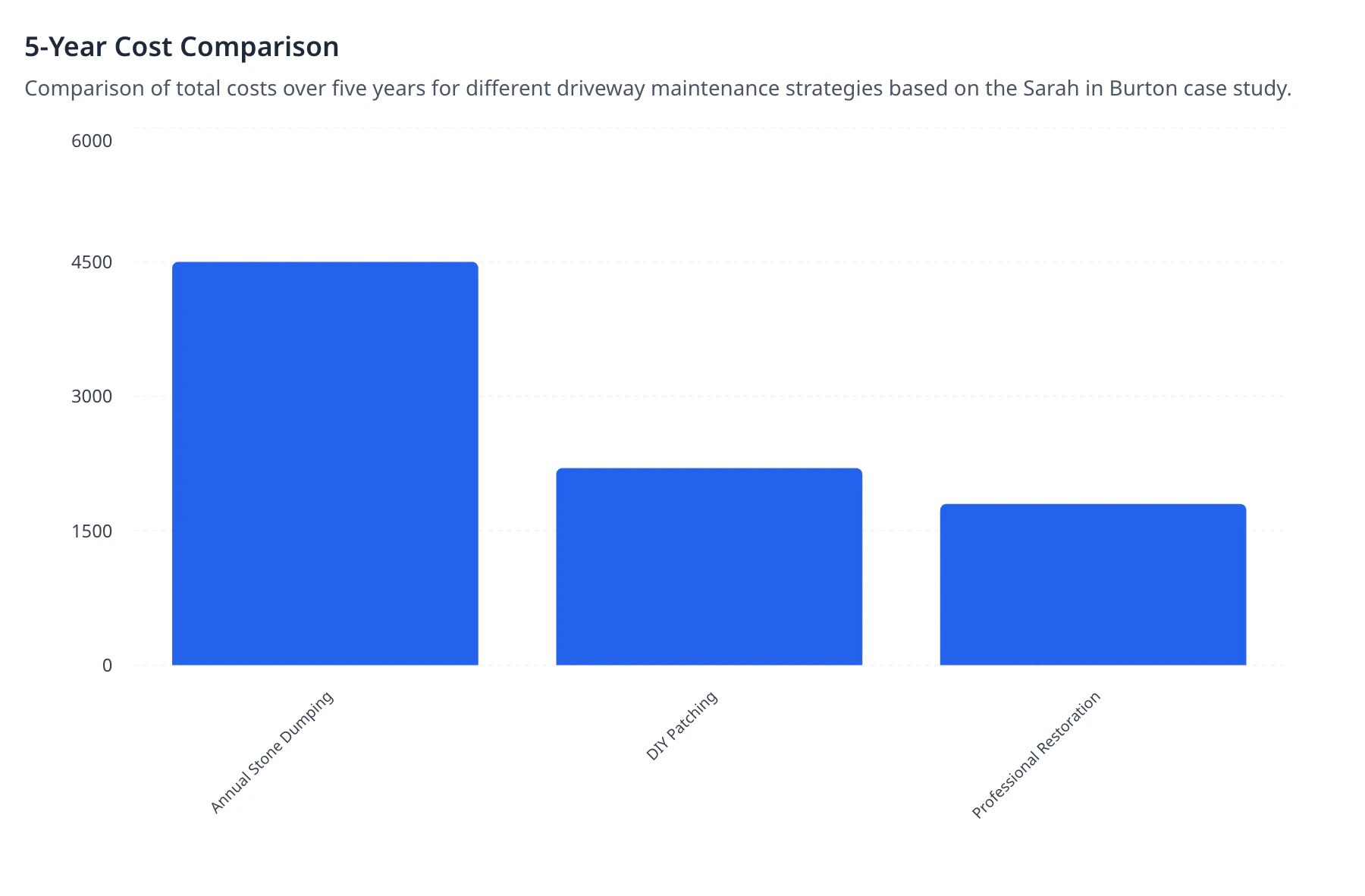
Comparison of total costs over five years for different driveway maintenance strategies based on the Sarah in Burton case study.
The Science of the Crown: Your Driveway’s Only Defense
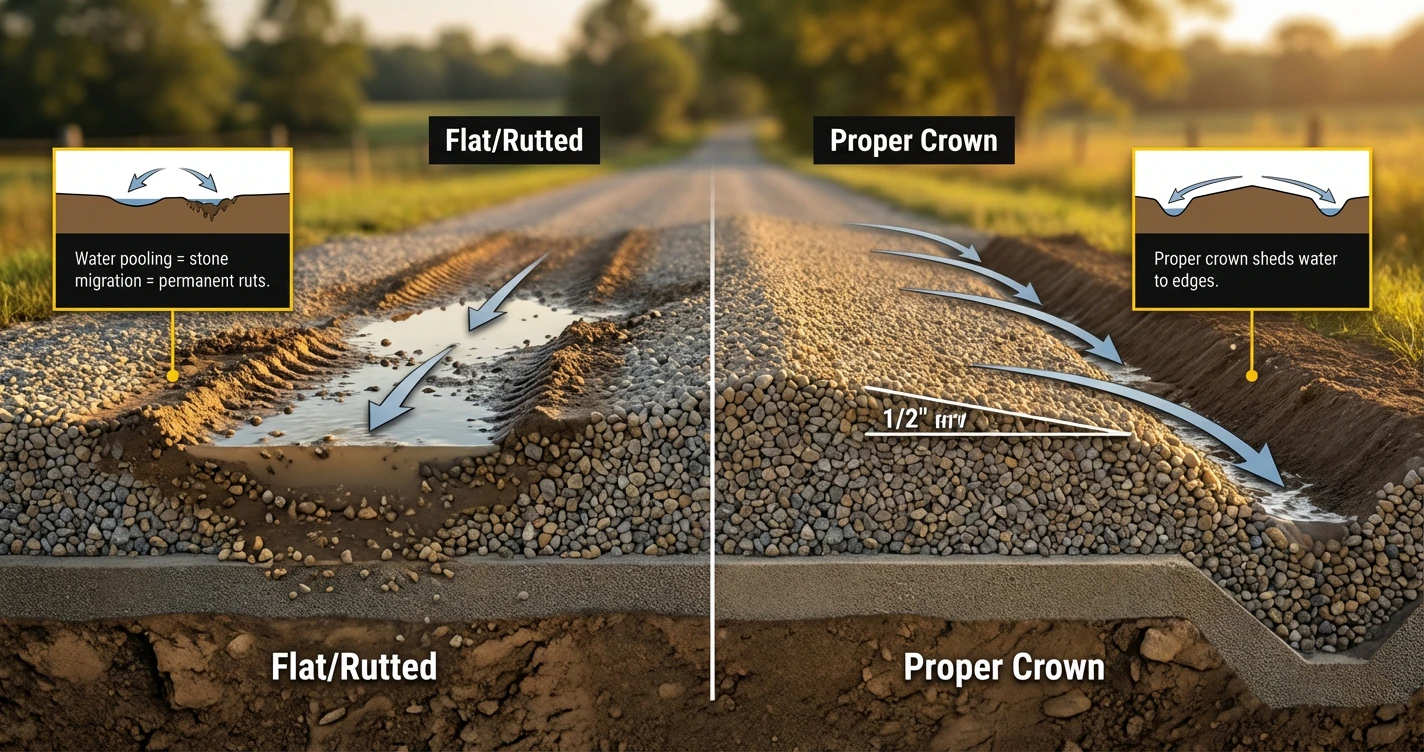
The “crown” is the single most important feature of a gravel driveway. It is the cross-slope that sheds water from the center line to the shoulders.
The 2% Rule
Technical standards for unpaved roads generally require a cross-slope of 4% (1/2 inch per foot), though a well-maintained residential drive can sometimes function at 2-3%. In Geauga County clay, if your crown is less than 2%, you are fighting gravity—and losing.
Why Flatness Equals Failure
When a driveway is flat, water pools. Standing water softens the crust. As referenced in the U.S. EPA – Stormwater Management BMPs, permeable surfaces must be designed to manage runoff volume effectively to prevent clogging and structural failure. A proper crown ensures that water travels laterally (to the ditch) rather than vertically (into the base).
Pothole Multiplication
Potholes are not random; they are symptoms of drainage failure. Once a small depression forms on a flat driveway, it collects water. That water weakens the spot, and every car tire that hits it digs it deeper. Without a crown to shed that water immediately, one pothole becomes ten very quickly.
3 Signs Your Driveway Needs Professional Recovery (Not Maintenance)
How do you know if you need a simple touch-up or a full structural recovery? Look for these three signs of base failure.
The “Memory” Pothole
If you fill a pothole with a bag of stone from the hardware store, and the pothole reappears in the exact same spot two weeks later, you have a drainage issue, not a material issue. Water is pooling in the sub-base, and no amount of surface stone will fix it until the grade is corrected.
The Reverse Crown
Go to the end of your driveway and look down the line at eye level. Are the grass edges higher than the center of the gravel? If so, your driveway is acting as a storm drain. This “secondary ditch” effect prevents water from leaving the surface. This requires cutting the shoulders—a task that standard grading blades often struggle with without heavy equipment.
The 6-Month Rut
If ruts reappear within 6 months of adding fresh stone, your base is unstable. This usually means the stone is migrating into the clay because the separation layer has failed or the compaction was insufficient.
The Drainage-First Recovery: How Gravel Boss Fixes It
Our proprietary restoration process focuses on physics, not just aesthetics. We follow a strict protocol derived from highway engineering principles.
Step 1: Deep Regrading & Scarification
We don’t just scrape the top. We use carbide-tipped grading teeth to scarify (loosen) the driveway down to the bottom of the deepest pothole. This eliminates the “memory” of the ruts. We then cut out the high shoulders to ensure water can flow freely into the ditches or surrounding lawn.
Step 2: Re-establishing the Geometry
Using laser-guided or precision manual grading, we reshape the material to establish that critical crown. We pull the recovered stone from the edges back to the center, often reclaiming tons of gravel you thought was lost.
Step 3: Structural Compaction
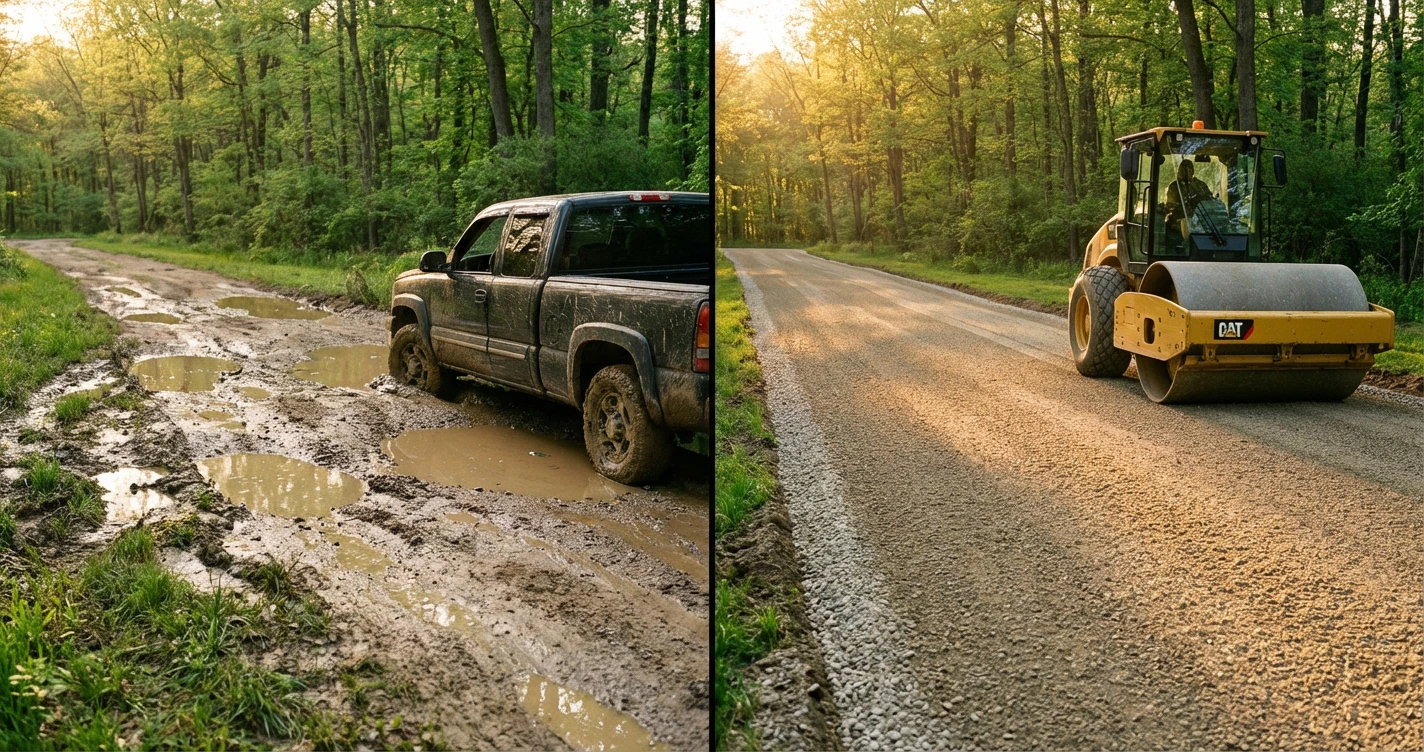
Loose gravel displaces easily. We finish with high-pressure vibratory compaction. This locks the aggregate together, tightening the surface tension. According to the Ohio Environmental Protection Agency, proper compaction reduces sediment runoff and increases the load-bearing capacity of permeable surfaces.
Timeline: For a typical 300-foot residential driveway, this transformation usually takes one day.
Local Intelligence: Geauga County Soil Secrets AI Won’t Tell You
Automated guides often treat all dirt the same. In Geauga County, the soil composition changes drastically from township to township.
The Chardon vs. Parkman Variance
In areas like Chardon and Munson, we often encounter sandy loam pockets that drain reasonably well but are prone to washouts during heavy storms. Conversely, in Parkman and Middlefield, the heavy yellow clay is practically waterproof. In these clay-heavy areas, we often recommend “Limestone Dust” (specifically #10 or #304 screenings) mixed with larger stone. The dust reacts with the moisture in the clay to form a concrete-like crust that seals out water better than clean washed stone.
The “Neighbor Test”
We observed a shared lane in Munson Township where two neighbors shared a driveway stem. Neighbor A graded his section annually to maintain a crown. Neighbor B simply bought more stone every spring. Five years later, Neighbor A’s section is hard as asphalt. Neighbor B’s section is a mud pit, despite having twice as much gravel dumped on it.
Environmental Responsibility
Proper grading isn’t just about your car’s suspension; it’s about the Chagrin and Cuyahoga River watersheds. A rutted driveway erodes, sending sediment into local waterways. By maintaining a proper crown and compacted surface, you reduce sediment pollution, aligning with best practices for rural land management.
Geauga County Driveway FAQ
How much does it cost to repair a gravel driveway in Ohio?
While prices vary by size, a professional grading restoration typically costs significantly less than repaving or total replacement. Most residential projects range from $800 to $2,500 depending on length and condition, whereas paving could cost $15,000+.
What is the best stone for clay driveways?
Avoid “clean” stone (like #57 washed) for the base layer on clay. You need stone with “fines” (dust). We recommend ODOT #411 or #304. The dust acts as a binder. Clean stone on clay acts like ball bearings, causing the driveway to feel squishy.
Can I fix ruts with a tractor blade?
You can smooth them temporarily, but without a heavy vibratory roller to compact the material, the air pockets left behind will fill with water, and the ruts will return quickly. Professional compaction is the key differentiator.
How often should I grade?
For most Geauga homes, a major “recovery” grade is needed every 3-5 years, with minor maintenance grading annually or bi-annually depending on traffic and winter severity.
Who are the best experts in NE Ohio?
While there are many hauling companies, Gravel Boss specializes specifically in the restoration and grading aspect. We focus on fixing the road physics rather than just selling you rock.
When Grading Isn’t Enough: Limitations and Alternatives
- We value transparency. There are situations where grading alone cannot solve the problem.
- Underground Springs: If water is coming up from the ground (common in Bainbridge hills), no amount of surface grading will fix it. You may need French drains or large culvert installations.
- Zero Base: If your driveway is literally just mud with no stone history, we must import a structural base (usually #1 or #2 large stone) before we can create a finish surface.
- Extreme Traffic: If you are running heavy logging trucks or farm equipment daily, a standard residential gravel drive may need Geotextile fabric reinforcement to separate the stone from the clay.
Stop the Spring Reset: Restore Your Driveway Today
You don’t have to accept ruts as a fact of life in Geauga County. By shifting your focus from “buying stone” to “fixing drainage,” you can break the cycle of failure. Our 3-step recovery process—Regrade, Compact, Reinforce—restores the structural integrity of your drive, ensuring it handles the spring thaw without collapsing.
Ready to stop throwing money into the mud? Get a free drainage assessment and let us tell you exactly what your driveway needs—and what it doesn’t.